Structural Drying in Cedar Park, TX
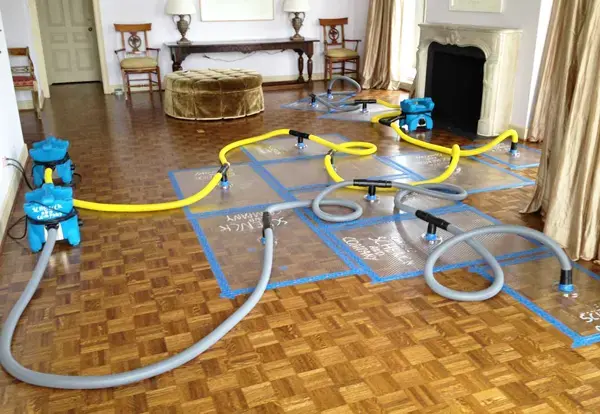
Surface dry is not structure dry. The drying team sets air movers and dehumidifiers to the evaporation load of each room and keeps them running until framing, drywall, flooring and the slab reach a verified reading.
(888) 926-4485Get the Cedar Park drying crew moving- IICRC S500 drying goal
- Truck-mounted extraction
- 24/7 dispatch
What to do the moment you find wet walls and floors
Stop the water source
Drying cannot start until the leak or flood has stopped.
Keep the house closed
Run the AC and keep windows shut so humid air stays out.
Leave equipment running
Do not switch off air movers or dehumidifiers between readings.
Call if readings stall
A room that stops drying needs the setup adjusted.
The standard behind structural drying in Cedar Park
Rapid local response
The Cedar Park restoration crew answers 24/7 and treats every active leak or flood as urgent, nights and weekends included.
IICRC S500 drying standard
The drying team maps moisture first, sets air movers and LGR dehumidifiers to the load, and keeps equipment running until the readings say dry.
Claim-ready documentation
Timestamped photos, a moisture map and daily drying logs go into the file an adjuster reviews.
Hill Country water experts
Slab foundations over limestone, attic air handlers and Brushy Creek cloudbursts shape how water moves through a Cedar Park home.
What does structural drying cost in Cedar Park, TX?
In Cedar Park, TX, structural drying typically runs $1,500 to $6,500. The drivers are the class of loss, the square footage, the number of air movers and dehumidifiers, specialty drying for hardwood or slab, and the number of drying days.
One or two rooms
$1,500 to $2,800- Class 1 to 2 setup
- 3 to 4 days of equipment
- Daily readings
Multi-room or hardwood
$2,800 to $4,800- Floor drying mats
- Cavity injection
- LGR dehumidifiers
Class 4 or slab-level
$4,800 to $6,500+- Desiccant dehumidification
- Extended monitoring
- Slab surface drying
These are typical ranges, not a quote. The drivers are the water category, the square footage, the material class and how fast drying started. Try the water damage cost calculator for a planning number.
How structural drying is handled in Cedar Park
- 1
Walkthrough and moisture map
The tech who does the walkthrough finds the source, confirms it is stopped, and maps moisture with pinless meters and thermal imaging before any equipment goes down.
- 2
Extraction
The extraction crew pulls standing water with truck-mounted extraction, so the water leaves the house instead of wicking into the next room.
- 3
Drying set to the load
The drying team places air movers and LGR dehumidifiers for the evaporation load of each room, and opens cavities only where the readings call for it.
- 4
Verify and document
Readings are logged daily, and equipment comes out once wet materials sit within 2 to 4 points of a dry reference material in the same house.
Structural drying is the part of water damage restoration that decides whether a loss comes back as swelling, odor or mold a month later. It is the controlled removal of moisture from the materials of the house itself: framing, subfloor, drywall, cabinets, hardwood and the slab surface. It works to a number, not a feeling.
How the drying plan is built
The tech who does the walkthrough starts with a moisture map. Pinless meters and thermal imaging show which materials are wet and how wet, and a dry reference reading is taken from the same material in an unaffected room. The drying team then sizes the equipment:
- Air movers set to the evaporation load of each room, aimed along wet walls and floors
- LGR (low grain refrigerant) dehumidifiers that pull moisture back out of the air
- Desiccant dehumidifiers for dense Class 4 materials like hardwood and plaster
- Floor drying mats and wall cavity injection where water is trapped
Daily readings and the drying goal
Every day the drying team records temperature, relative humidity and grains per pound in the affected rooms and outside, along with moisture readings on the marked materials. Those psychrometric logs show whether the drying is working, and the IICRC S500 standard uses them to decide when to adjust equipment. Equipment comes out when wet materials read within 2 to 4 points of the dry reference, not after a fixed number of days.
Class 1 through 4 sets how much equipment a room needs. A carpeted Class 2 bedroom and a hardwood Class 4 living room need very different setups.
Central Texas conditions
Cedar Park summers are hot, and spring and fall storms bring humid air, so the drying team keeps the work area closed and lets the dehumidifiers do the work instead of opening windows. Slab-level losses and hardwood take longest. The EPA moisture guide explains why drying fast and fully matters, and Texas A&M AgriLife Extension covers humidity and home moisture basics for Texas.
Structural drying follows water extraction on nearly every job, and it is the core of slab leak water damage work.
Structural Drying across Cedar Park and nearby towns
The Cedar Park restoration crew works every street in 78613 and 78630, plus the towns around it, 24/7.
Drying crews cover all of Cedar Park, from Buttercup Creek and Cypress Creek to Twin Creeks and the neighborhoods along Brushy Creek.
Coverage also runs into Leander, Round Rock, Brushy Creek, Jollyville, Anderson Mill, Four Points and northwest Austin.
See every neighborhood and ZIP coveredStructural Drying questions in Cedar Park, TX
What is the difference between drying and structural drying?
Drying the surface makes a floor look dry. Structural drying removes moisture from framing, cavities, flooring and the slab and proves it with readings.
Why is the equipment so loud?
Air movers push large volumes of air across wet surfaces. The noise is temporary and the equipment needs to run continuously.
Can I turn the equipment off at night?
Keep it running. Switching it off lets humidity rebuild and adds days to the job.
How is dry measured?
Wet materials are compared with a dry reference reading from the same material elsewhere in the house. The goal is within 2 to 4 points.
Does hardwood always need special drying?
Often. Floor drying mats and desiccant dehumidifiers help pull water out of dense wood without cupping it further.
Is structural drying covered by insurance?
Drying after a covered sudden loss is usually part of the mitigation claim. Coverage depends on your policy, so it is worth checking with your own insurer.
Structural Drying in Cedar Park? Call now for emergency water removal.
Water that reaches the slab and the bottom plates is the hardest part of a house to dry. The drying team extracts first, sets equipment to the load and keeps it running until the meters agree.