Slab Leak Water Damage in Cedar Park, TX
A pressurized line leaking under the foundation soaks flooring and baseboards from below. The restoration team confirms the wet area, opens only what the readings call for and dries the slab surface to a verified number.
(888) 926-4485Get the Cedar Park drying crew moving- IICRC S500 drying goal
- Truck-mounted extraction
- 24/7 dispatch
What to do the moment you find a slab leak
Shut off the main valve
Stop the pressure on the broken line at the main valve or the meter box.
Turn off the water heater
If the warm spot suggests a hot-side leak, switch off the heater so it does not run dry.
Photograph the floor and baseboards
Capture the damp areas and the meter reading before anything is moved.
Call for mapping and drying
Get the wet area mapped so only the soaked materials come out.
The standard behind slab leak water damage in Cedar Park
Rapid local response
The Cedar Park restoration crew answers 24/7 and treats every active leak or flood as urgent, nights and weekends included.
IICRC S500 drying standard
The drying team maps moisture first, sets air movers and LGR dehumidifiers to the load, and keeps equipment running until the readings say dry.
Claim-ready documentation
Timestamped photos, a moisture map and daily drying logs go into the file an adjuster reviews.
Hill Country water experts
Slab foundations over limestone, attic air handlers and Brushy Creek cloudbursts shape how water moves through a Cedar Park home.
What does slab leak water damage cost in Cedar Park, TX?
In Cedar Park, TX, slab leak water damage cleanup typically runs $1,500 to $7,500, not counting the plumbing repair. The drivers are how many rooms the water reached, the flooring type, how much drywall wicked water and how long the leak ran.
Caught early, one room
$1,500 to $3,000- Wet pad and tack strip removed
- Slab surface and baseboards dried
- 3 to 5 days of equipment
Several rooms or hardwood
$3,000 to $5,500- Laminate or wood removed
- Flood cuts on lower drywall
- Floor mats or desiccant drying
Long-running hot-side leak
$5,500 to $7,500+- Multiple rooms and a hallway
- Antimicrobial on the slab
- Extended Class 4 drying
These are typical ranges, not a quote. The drivers are the water category, the square footage, the material class and how fast drying started. Try the water damage cost calculator for a planning number.
How slab leak water damage is handled in Cedar Park
- 1
Walkthrough and moisture map
The tech who does the walkthrough finds the source, confirms it is stopped, and maps moisture with pinless meters and thermal imaging before any equipment goes down.
- 2
Extraction
The extraction crew pulls standing water with truck-mounted extraction, so the water leaves the house instead of wicking into the next room.
- 3
Drying set to the load
The drying team places air movers and LGR dehumidifiers for the evaporation load of each room, and opens cavities only where the readings call for it.
- 4
Verify and document
Readings are logged daily, and equipment comes out once wet materials sit within 2 to 4 points of a dry reference material in the same house.
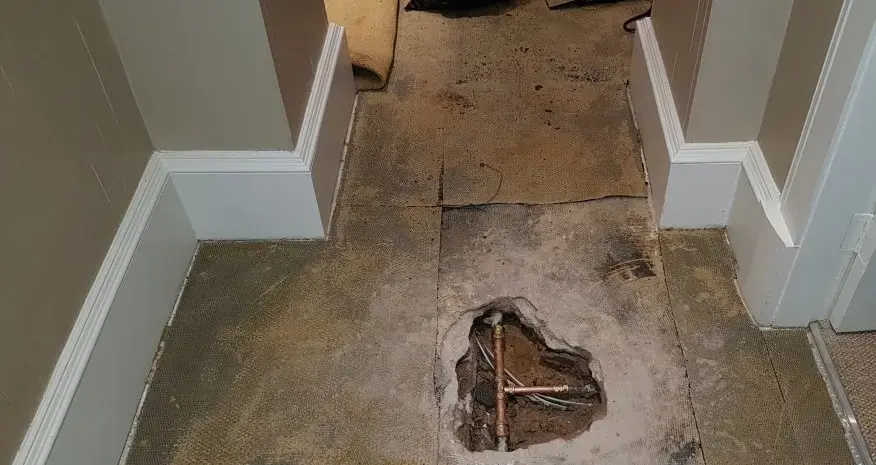
Most Cedar Park homes built from the 1980s through the 2000s sit on a concrete slab with the supply plumbing running below or inside it. When a hot-water line wears through against the concrete, or a fitting lets go as the soil moves, the water has one way out: up through the flooring and along the walls. By the time a floor feels damp, the pad, the tack strip and the bottom of the drywall have often been wet for days.
How a slab leak shows up in a Cedar Park house
A slab leak rarely looks like a flood. It looks like small things that do not add up, and the tech who does the walkthrough uses them to trace the wet zone before anything gets torn out.
- A warm spot on tile or wood flooring, usually over a hot-water line
- Carpet that stays damp along one wall with no spill nearby
- Baseboards swelling or paint bubbling near the floor
- A water bill that climbs while habits stay the same, or a meter that moves with every fixture off
The hidden leak calculator turns a water bill and a meter test into a rough gallons-per-day figure, which helps decide how urgent the call is.
What the restoration team does, and what the plumber does
Two trades work a slab leak. A plumber locates the break and either repairs it through the slab or reroutes the line through the attic or walls. The restoration team handles everything the water reached: thermal imaging and pinless meters to map the wet area, removal of wet pad and carpet or failed laminate, flood cuts where drywall has wicked water, and drying of the slab surface and the bottom plates.
Concrete gives up water slowly, so slab-level losses often run as Class 4. The drying team pairs air movers with LGR dehumidifiers and sometimes a desiccant unit, and keeps readings daily until the slab surface and the framing sit within 2 to 4 points of a dry reference in the same house.
Hot-side slab leaks feed warm water into the flooring, which speeds up swelling and odor. Early extraction and removal of soaked pad keep the loss smaller.
Why soil and limestone matter here
Cedar Park sits where the limestone of the Hill Country meets pockets of clay. Long dry stretches followed by heavy rain move that soil, and the slab and the pipes under it move with it. The Texas Water Development Board and the EPA WaterSense program both publish plain advice on finding household leaks early, which is the cheapest way to keep a slab leak small.
If the leak has already reached the flooring, related work often includes structural drying of the framing and, where laminate or hardwood cupped, flooring removal before the dry-out.
Slab Leak Water Damage across Cedar Park and nearby towns
The Cedar Park restoration crew works every street in 78613 and 78630, plus the towns around it, 24/7.
Drying crews cover all of Cedar Park, from Buttercup Creek and Cypress Creek to Twin Creeks and the neighborhoods along Brushy Creek.
Coverage also runs into Leander, Round Rock, Brushy Creek, Jollyville, Anderson Mill, Four Points and northwest Austin.
See every neighborhood and ZIP coveredSlab Leak Water Damage questions in Cedar Park, TX
Does the restoration team fix the pipe under the slab?
No. A plumber locates and repairs or reroutes the line. The restoration team maps and dries everything the water reached, and the two trades usually coordinate on timing.
Can a wet slab dry without removing all the flooring?
Sometimes. Tile set directly on the slab can often stay if readings drop, but carpet pad, laminate and floating floors usually come up so the slab surface can breathe.
How long does a slab leak dry-out take?
A slab-level loss often takes four to seven days because concrete releases moisture slowly. Equipment stays until the readings reach the drying goal.
Is slab leak water damage covered by insurance?
Many Texas policies cover the resulting water damage and sometimes the cost of accessing the pipe, but not always the pipe itself. Coverage depends on your policy, so it is worth checking with your own insurer.
Why does the floor feel warm?
A leak on the hot-water line pushes heated water into the slab under the flooring, which shows up as a warm patch you can feel or see on a thermal camera.
Will a rerouted line stop future slab leaks?
Rerouting through the attic or walls takes the replaced run out of the slab, which is why many Cedar Park plumbers recommend it on older homes. It does not change the drying work needed for the current loss.
Slab Leak Water Damage in Cedar Park? Call now for emergency water removal.
Water that reaches the slab and the bottom plates is the hardest part of a house to dry. The drying team extracts first, sets equipment to the load and keeps it running until the meters agree.